
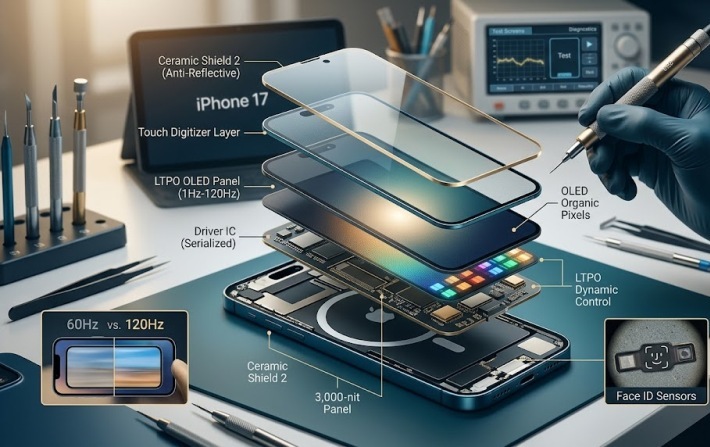
Smartphone screen technology took a massive leap forward with the release of the iPhone 17 lineup. For the first time, Apple has democratized its premium display features, bringing the 120Hz ProMotion experience and advanced LTPO panels to the base model iPhone 17, alongside the Pro and Pro Max variants.
While these ultra-bright, super-smooth screens look incredible out of the box, their highly integrated architecture completely changes the game when it comes to accidental damage and display restoration. If you drop your device and end up with a shattered pane or a flickering image, understanding the mechanics of a modern iPhone 17 screen repair is vital to ensuring you get your phone back to factory-spec performance.
Key Takeaways at a Glance
| Feature / Detail | What It Means For Your iPhone 17 | Impact on Screen Repair |
| OLED Panel | Individual organic pixels; deep blacks, high contrast ratio. | Requires exact matching; cheap LCD substitutes ruin battery and colors. |
| LTPO Substrate | Dynamically scales refresh rate between 1Hz and 120Hz. | Demands highly precise calibration to prevent erratic flickering. |
| Peak Brightness | Reaches up to 3,000 nits in outdoor environments. | Poor aftermarket screens struggle to cross 1,000 nits, causing glare. |
| Ceramic Shield 2 | Toughened front glass layer with anti-reflective coating. | Glass is fused to the OLED panel; single-unit swap is required. |
| Micro-Component Sync | Dynamic Island, Face ID, and True Tone sensors are serialized. | Micro-soldering and serial rewriting are necessary to preserve features. |
Breaking Down the Tech: What Makes the iPhone 17 Screen Different?
To understand why an iPhone 17 screen repair requires a specialized hands-on approach, we first have to break down the underlying components that Apple engineers packed into this 6.3-inch and 6.9-inch display architecture.
1. Organic Light Emitting Diode (OLED)
Unlike older Liquid Crystal Displays (LCDs) that rely on a global backlight to illuminate pixels from behind, the iPhone 17 uses an advanced OLED panel. In an OLED display, every single pixel generates its own light and color.
When you look at true black on your screen, those specific pixels turn off completely. This achieves an infinite 2,000,000:1 contrast ratio. However, because the organic compounds are delicate, any micro-fracture or impact pressure can cause immediate pixel bleeding, green lines, or total display blackout.
2. Low-Temperature Polycrystalline Oxide (LTPO)
This is the real superstar of the iPhone 17 series. LTPO is a special type of thin-film transistor (TFT) backplane technology. Its main job is to control how much power goes to the OLED display while varying the refresh rate dynamically via ProMotion.
- Static Images: When looking at a static photo or the Always-On display, the screen drops all the way down to 1Hz (updating just once per second) to conserve battery.
- Fast Motion: The moment you scroll or launch a game, it instantly ramps up to 120Hz for buttery-smooth animations.
The Repair Catch: LTPO requires extremely tight voltage synchronization. If a replacement panel is not built with high-quality driver IC chips, the phone won’t handle these rapid refresh shifts correctly, leading to severe battery drain or subtle micro-stuttering.
The Realities of iPhone 17 Screen Repair: A Workshop Perspective
In our repair workshop, we witness firsthand how shifting smartphone tech impacts everyday fixes. Gone are the days when a screen replacement meant just unscrewing a few brackets and popping in a generic glass lens. The iPhone 17 is a highly calibrated piece of visual engineering.
When handling an iPhone 17 screen repair, three critical roadblocks must be addressed:
The Anti-Reflective Layer & Ceramic Shield 2
Apple upgraded the outer glass to Ceramic Shield 2, which features embedded ceramic nanocrystals to absorb impacts better. They also applied a new anti-reflective coating that dramatically cuts down ambient glare.
When a screen shatters, the glass layer, the touch-sensitive digitizer, and the underlying LTPO OLED display must be replaced as a pre-bonded assembly. Attempting to isolate just the glass layer without factory-grade cleanroom equipment will destroy the delicate organic pixels beneath.
Preserving True Tone & High Peak Brightness
The iPhone 17 display can push a staggering 3,000 nits of peak outdoor brightness. Cheap, low-tier aftermarket copy screens usually max out at less than half of that value, leaving you squinting in the sunlight. Furthermore, the ambient light sensors that control True Tone (adjusting screen warmth to match room lighting) are serialized to the logic board.
Without transferring the data chip data or utilizing premium parts, True Tone functionality will be permanently disabled after a screen swap.
Face ID and Sensor Realignment
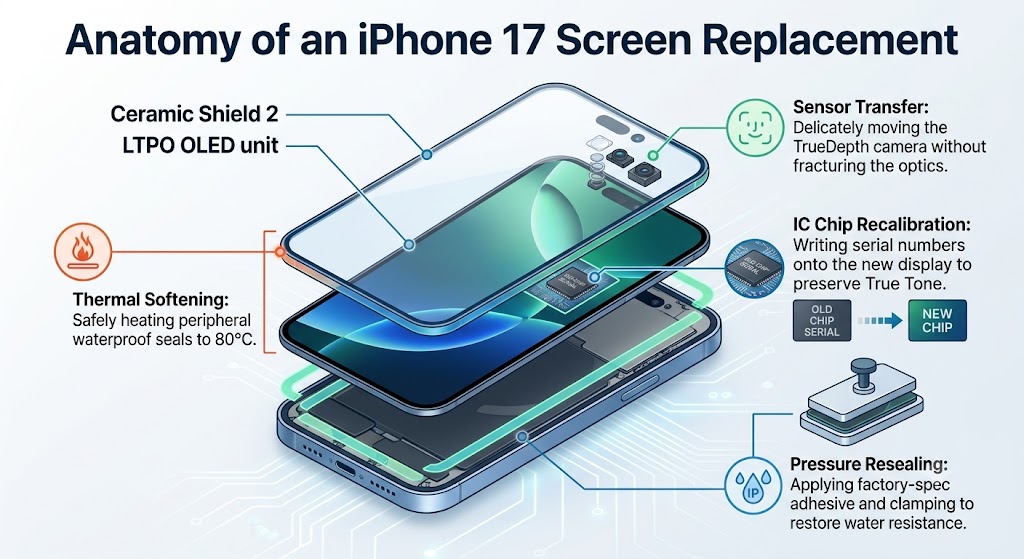
The Dynamic Island cutout houses the highly sensitive TrueDepth camera matrix responsible for Face ID. During a tear-down, these sensors must be handled with extreme care under a microscope. A single smudge or hair-thin tear in the flexible ribbon cables will break your facial recognition entirely.
[Broken iPhone 17 Screen]
         │
         ▼
[Micro-Screws & Adhesive Softening]
         │
         ▼
[Careful Disassembly of TrueDepth/Face ID Module]
         │
         ▼
[EEPROM Chip Data Copying (For True Tone Sync)]
         │
         ▼
[Installation of Premium LTPO OLED Assembly]
         │
         ▼
[Factory Adhesive Resealing & Calibration Test]
Why Low-Quality Aftermarket Screens Ruin Your Device
It can be tempting to choose the cheapest possible fix when looking for a repair option. However, cutting corners on an LTPO OLED device causes immediate performance issues.
- Massive Battery Drain: Standard aftermarket displays lack true LTPO architecture. Instead of dynamically downscaling to 1Hz, they draw a constant 60Hz or 120Hz power load, chewing through your battery up to 30% faster.
- Touch Delays & “Ghost” Touches: The digitizer layer on generic parts often struggles with rapid multitouch tracking, making fast typing or mobile gaming incredibly frustrating.
- Thicker Bezels & Color Distortion: Apple shrank the display bezels significantly on the iPhone 17. Cheap clone panels feature thicker plastic borders and a noticeable blue or grey color tint when viewed from an angle.
Frequently Asked Questions
1. Will an iPhone 17 screen repair affect my Face ID functionality?
Not if the repair is completed by an experienced technician using the correct procedures. The Face ID hardware is tied directly to your phone’s main logic board. As long as the sensor array is carefully transferred to the new screen assembly without physical or static damage, Face ID will work flawlessly.
2. What is the difference between Soft OLED and hard aftermarket screens?
Soft OLEDs are built on a flexible substrate that matches original manufacturing standards, offering rich colors and high impact resilience. Hard OLEDs are cheaper, thicker, and highly fragile; even a minor bump can crack their internal matrix without shattering the outer glass.
3. Why did my screen turn completely black after a minor drop?
Because OLED pixels are self-lit, a hard shock can sever the micro-thin power traces running through the LTPO backplane. Even if your outer Ceramic Shield glass has no visible cracks, the internal display panel can die completely, requiring a full screen replacement.
4. Can I still use my phone if it only has a small hairline crack?
While it may function temporarily, a hairline crack compromises the structural integrity of the display. Moisture, pocket lint, and everyday pressure will seep through the fissure, eventually causing the underlying touch digitizer to fail or the OLED to develop bright green vertical lines.
Restoring Your Smartphone with Confidence
When your high-end display meets the concrete, don’t let a subpar repair undermine your smartphone investment. Keeping the complex interaction of LTPO, ProMotion, and Face ID synchronization operating smoothly requires precision tools, premium parts, and rigorous testing.
If your device has suffered an accidental drop, let the professionals handle it safely. For reliable, top-tier diagnostic care and precision screen replacements, bring your device to the experts at Phonebulance. Our experienced technicians ensure your smartphone’s display tech is restored safely to factory-fresh clarity and responsiveness.
This comprehensive technical guide was curated, reviewed, and approved by a senior mobile hardware specialist from our partner network, leveraging years of hands-on experience in premium smartphone display restoration, micro-soldering diagnostics, and smart vehicle system integrations.
Make Appointment Now!
Phonebulance is your one-stop center for all things smartphone! Whether you’ve cracked your screen, dropped it in water, or it’s simply acting sluggish, our certified technicians can diagnose and fix a wide range of issues.
Contact us today or make an online appointment to learn more about our services and keep your smartphone connected and functioning like new!
Here is the list of our smartphone repair services:
- Apple iPhone
- Apple Watch
- Apple iPad
- Apple iPod
- Samsung Galaxy S Series
- Samsung Galaxy Note Series
- Samsung Galaxy Tab
- Google Pixel and Nexus
- OnePlus
- Other brands (LG, Motorola, HTC, Blackberry…)
Here is the list of our repair and fixing prices:
- iPhone LCD Screen Replacement
- iPhone Charging Port Replacement
- iPhone Battery Replacement (High Capacity)
- iPad Screen Replacement
- iPhone Back Camera Lens Replacement
- iPhone Rear Camera Repair
- iPhone Back Glass Repair Cost
Service Areas in Orange County South:
0 Comments